

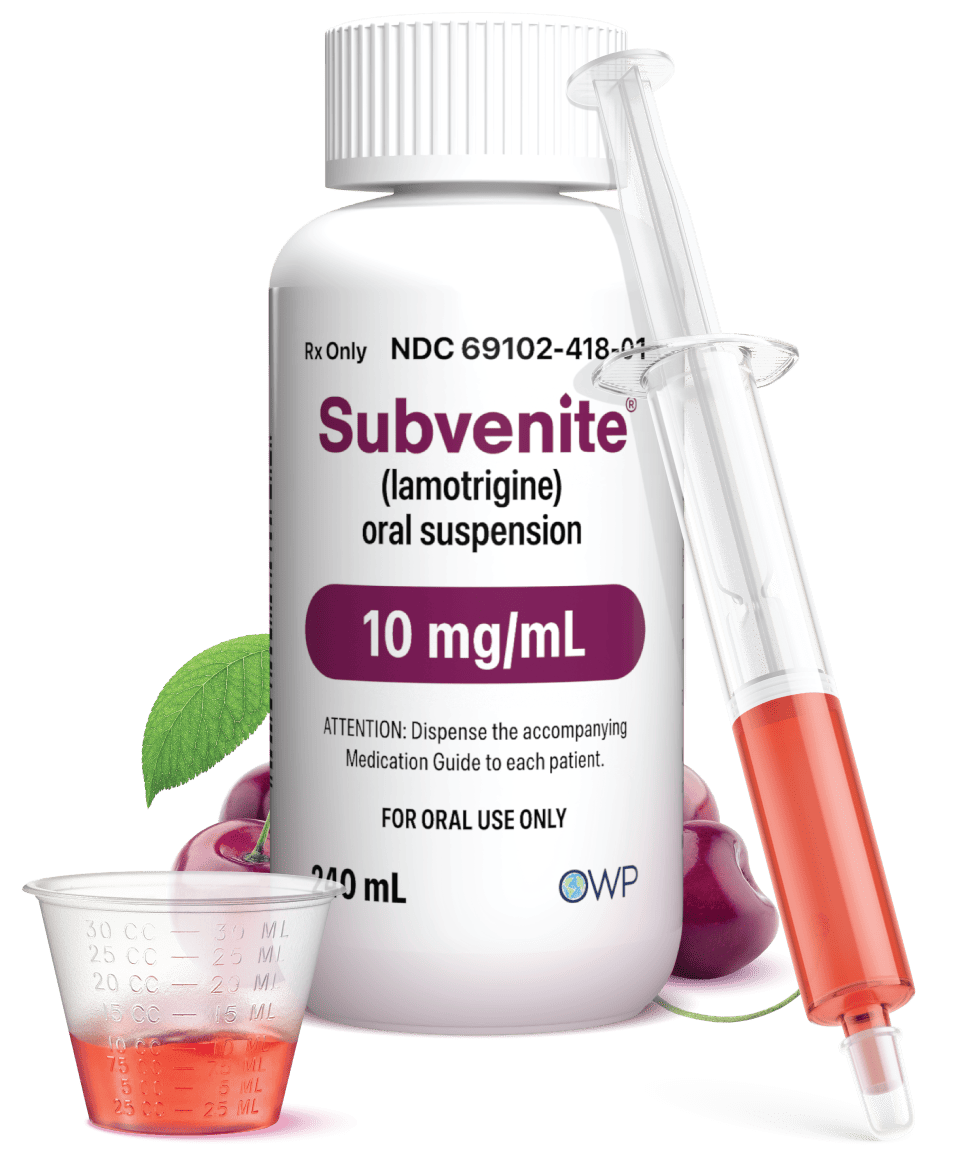



*Shake well before use
SUBVENITE is indicated for:
Epilepsy—adjunctive therapy in patients aged 2 years and older:
Epilepsy—monotherapy in patients aged 16 years and older: Conversion to monotherapy in patients with partial-onset seizures who are receiving treatment with carbamazepine, phenytoin, phenobarbital, primidone, or valproate as the single antiepileptic drug.
Bipolar disorder: Maintenance treatment of bipolar I disorder to delay the time to occurrence of mood episodes in patients treated for acute mood episodes with standard therapy.
SUBVENITE® (lamotrigine) Oral Suspension may help fulfill an unmet medical need by providing:
Eligible Commercial Patients pay as little as $0 with the SUBVENITE Patient Savings Card.*
*Subject to eligibility restrictions apply
A portion of the profits from the sale of SUBVENITE® helps support the humanitarian work of ROW Global Health ↗, an organization dedicated to help bring training, diagnostics, and treatment to under-resourced communities around the world.
If you are a patient currently taking lamotrigine or you are interested in learning more about SUBVENITE®, please visit the SUBVENITE® Oral Suspension Patient Page.
*Lamictal® is a registered trademark of GlaxoSmithKline, Inc. †Terms and conditions apply; see lamotriginestarterkits.com/savings-program. 1https://www.goodrx.com/lamictal?dosage=49-tablets-of-25mg-and-100mg-orange&form=kit&label_override=Lamictal&quantity=1. 2Conn VS, et. al. Current Medical Research and Opinion. 2015;31:1;145-160. 3Gutierrez PM, et. al. Journal of Psychiatric Practice. 2017;23:5;320–327. 4Peterson GM, et. al. Epilepsia. 1984;25:4;412-417.
For general questions or inquiries please contact us at: info@owppharma.com. For SUBVENITE (lamotrigine) Oral Suspension medical questions please contact us at: medinfo.OWP@apcerls.com or call 1-800-273-6729 and follow the prompts for medical information requests. For SUBVENITE (lamotrigine) Oral Suspension safety-related concerns please contact us at: safety.OWP@apcerls.com or call 1-800-273-6729 and follow the prompts for medical adverse events reporting.
SUBOS1013V1 11/25

© 2025 OWP Pharmaceuticals, Inc. All rights reserved.
Naperville, IL 60563. Developed in USA.
WARNING: SERIOUS SKIN RASHES
Cases of life-threatening serious rashes, including Stevens-Johnson syndrome and toxic epidermal necrolysis, and/or rash-related death have been caused by lamotrigine, the active ingredient in SUBVENITE. The rate of serious rash is greater in pediatric patients than in adults. Additional factors that may increase the risk of rash include:
Benign rashes are also caused by lamotrigine, the active ingredient in SUBVENITE; however, it is not possible to predict which rashes will prove to be serious or life threatening. SUBVENITE should be discontinued at the first sign of rash, unless the rash is clearly not drug related. (5.1)
Please refer to the full Prescribing Information for SUBVENITE at www.subvenite.com.SUBVENITE is indicated for:
Epilepsy—adjunctive therapy in patients aged 2 years and older:
Epilepsy—monotherapy in patients aged 16 years and older: Conversion to monotherapy in patients with partial-onset seizures who are receiving treatment with carbamazepine, phenytoin, phenobarbital, primidone, or valproate as the single antiepileptic drug.
Bipolar disorder: Maintenance treatment of bipolar I disorder to delay the time to occurrence of mood episodes in patients treated for acute mood episodes with standard therapy.
Limitations of Use: Treatment of acute manic or mixed episodes is not recommended. Effectiveness of SUBVENITE in the acute treatment of mood episodes has not been established.
DOSAGE AND ADMINISTRATION
Epilepsy:
Adjunctive therapy—See Table 1 for patients older than 12 years and Tables 2 and 3 for patients aged 2 to 12 years. (2.2)
Conversion to monotherapy—See Table 4. (2.3)
Bipolar disorder: See Tables 5 and 6. (2.4)
DOSAGE FORMS AND STRENGTHS
CONTRAINDICATIONS
Hypersensitivity to the drug or its ingredients. (Boxed Warning, 4)
WARNINGS & PRECAUTIONS
ADVERSE REACTIONS
Epilepsy: Most common adverse reactions (incidence ≥10%) in adults were dizziness, headache, diplopia, ataxia, nausea, blurred vision, somnolence, rhinitis, pharyngitis, and rash. Additional adverse reactions (incidence ≥10%) reported in children included vomiting, infection, fever, accidental injury, diarrhea, abdominal pain, and tremor. (6.1)
Bipolar Disorder: Most common adverse reactions (incidence >5%) in adults were nausea, insomnia, somnolence, back pain, fatigue, rash, rhinitis, abdominal pain, and xerostomia. (6.1)
To report SUSPECTED ADVERSE REACTIONS, contact OWP Pharmaceuticals Inc. at 1-800-273-6729 or FDA at 1-800-FDA-1088 or www.fda.gov/medwatch.
DRUG INTERACTIONS
USE IN SPECIFIC POPULATIONS
See 17 for PATIENT COUNSELING INFORMATION and Medication Guide.
Please refer to the full Prescribing Information for SUBVENITE at www.subvenite.com.
09/2025